

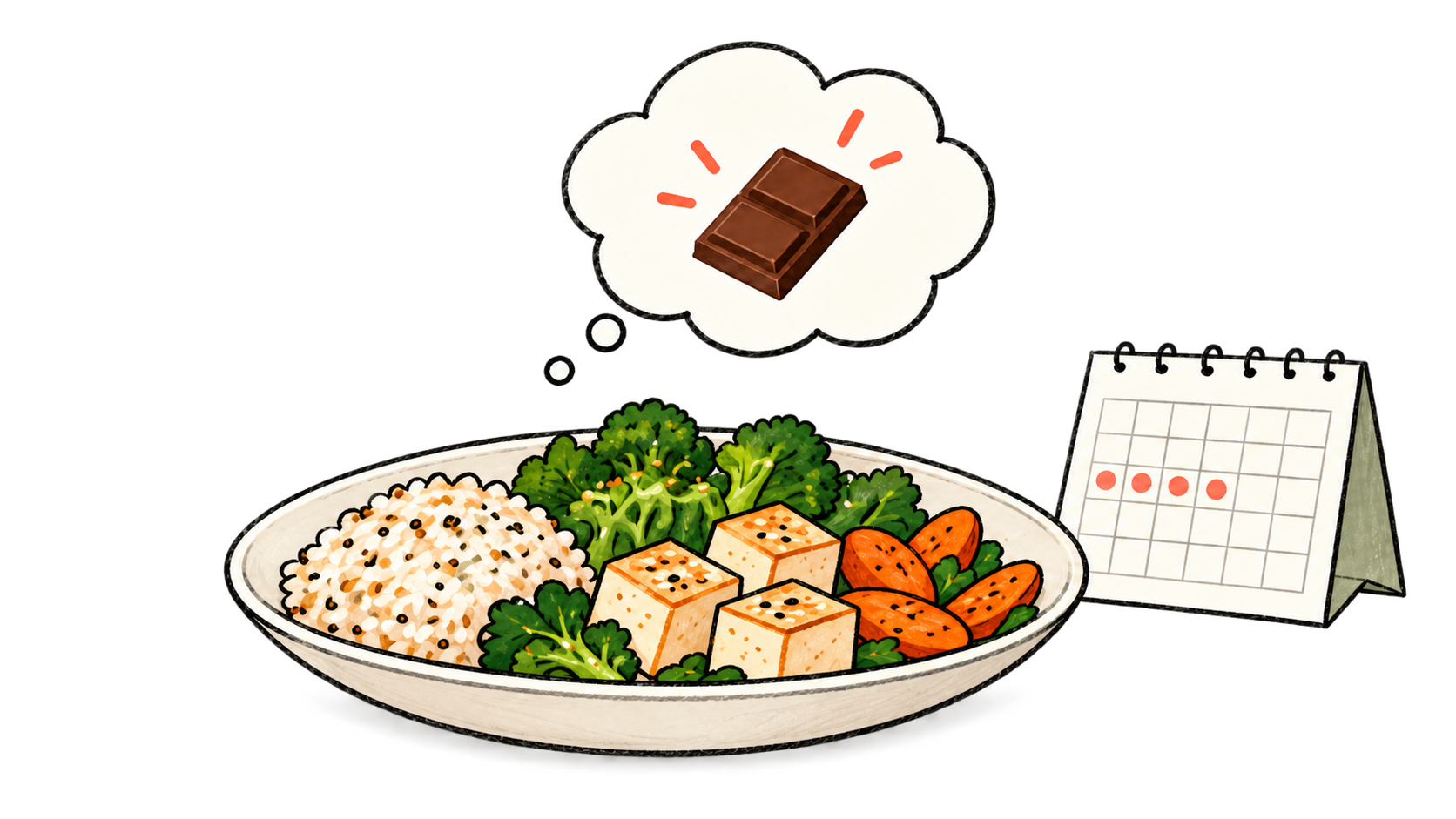
One week, your usual meals feel satisfying. The next, you are hungry again—and chocolate suddenly has excellent negotiating skills.
Could your menstrual cycle be part of the explanation? Yes. Does that mean you need a different diet for every phase? The evidence is much less convincing.
After our diabetes chapter, we’re turning to women’s nutrition, starting with what monthly hormonal changes actually mean for your plate.
First, a quick hormone map
The follicular phase begins on the first day of your period and continues until ovulation. Estrogen generally rises as ovulation approaches. After ovulation, the luteal phase begins, and progesterone rises. If pregnancy does not occur, these hormones fall before the next period.
These shifts can influence appetite and symptoms. But a calendar cannot tell every woman exactly how hungry or energetic she should feel.
Hungrier before your period? There is evidence for that.
A systematic review published in Nutrition Reviews in 2025 combined 15 datasets involving 330 women. Energy intake was higher in the luteal than the follicular phase, with a crude average difference of 168 kcal per day.
Here is the important distinction: the study measured how much participants ate—not how many extra calories everyone needs. The researchers also found inconsistencies in food measurement and cycle-phase identification. Participants were mainly young adults, and the analysis excluded hormonal-contraceptive groups.
So, this is evidence of an average pattern, not a prescription to add exactly 168 calories.
If you notice more hunger before your period, a larger meal or an extra snack can be a practical response. Try yogurt with fruit, edamame, or an egg with whole-grain toast. A craving can also fit into your day without becoming a dietary failure.
Does your metabolism speed up, too?
Possibly, but the size and consistency of the change remain uncertain.
A 2020 meta-analysis of 26 studies involving 318 women found a small increase in resting metabolic rate during the luteal phase. However, when researchers examined studies published from 2000 onward, the difference was no longer statistically significant.
That does not prove there is no effect. It does mean that confident claims such as “every woman burns hundreds of extra calories before her period” go beyond what this review establishes.
Iron deserves attention throughout the month
Menstrual blood loss increases the risk of iron deficiency, especially with heavy periods. Iron deficiency can cause fatigue and reduced exercise tolerance, even before anemia develops.
The standard recommended dietary allowance for nonpregnant, nonlactating women aged 19–50 is 18 mg of iron per day. Vegetarian diets require additional consideration because plant iron is less readily absorbed.
Useful sources include meat, seafood, tofu, beans, lentils, and iron-fortified cereals. Pairing plant sources with vitamin C—such as tofu with bell peppers or lentils with tomatoes—can improve absorption.
The goal is consistent intake, rather than trying to replace a month’s losses with one meal during your period.
If periods are heavy or fatigue persists, ask a clinician whether blood-count and ferritin testing are appropriate. Ferritin helps assess iron stores. Confirmed deficiency may need treatment beyond food changes.
What about workouts and PMS?
A systematic review in Sports Medicine found only a trivial average reduction in exercise performance during the early follicular phase, with substantial variation and generally low-quality evidence. The authors recommended an individual approach rather than universal training rules.
Adjust a workout when symptoms warrant it. There is no need to cancel strength training simply because an app labels the week “menstrual.”
Food cravings, appetite changes, and bloating can occur with PMS. Tracking symptoms can help identify your own pattern; symptoms that disrupt daily life deserve assessment.
What does this mean for “cycle syncing”?
There is a meaningful difference between responding to your symptoms and following a fixed menu designed to “balance hormones.”
The reviews above examine changes across the cycle. They do not demonstrate that assigning particular foods to each phase improves hormonal health. The practical conclusion is to keep your nutrition foundation consistent and make flexible changes when hunger or symptoms change.
As we explored in NutriNom’s earlier protein, fiber, and carbohydrate posts, those foundations already matter. This chapter adds the hormonal context.
You can start with three steps:
Notice patterns. Track hunger, bleeding, symptoms, and exercise comfort over a few cycles.
Respond flexibly. Adjust meal size and activity to how you feel.
Take persistent changes seriously. Restrictive eating and insufficient energy can contribute to absent periods, but other causes must also be assessed.
Most of the research discussed here concerns naturally cycling women. Its findings should not automatically be applied to hormonal contraception, irregular cycles, or pregnancy.
Your cycle can offer useful information. It does not need to become another set of food rules.
Coming up next
We’ve explored how the menstrual cycle can influence hunger, energy, and nutrition. Next, we’re looking at what happens when that hormonal pattern becomes less predictable.
In Part 2 of our Women’s Nutrition & Hormonal Health Across the Lifespan Series, we’re turning our attention to polycystic ovary syndrome (PCOS).
We’ll explore how PCOS connects with insulin resistance, menstrual health, and fertility—and separate evidence-based nutrition advice from the many “hormone-balancing” promises online.
PCOS and Nutrition: What Helps—and What the Internet Gets Wrong
Do you need to cut carbohydrates, avoid dairy, or go gluten-free? We’ll examine what the research supports and how to build a practical approach without unnecessary food restrictions.
See you in Part 2!
If this post was useful to you, share it with someone who might benefit, and follow our WeChat page or Substack for more evidence-based nutrition made accessible to everyone.