

In our first four posts, we covered what diabetes is, how insulin works and fails, how high blood sugar damages your organs, and why prediabetes is your best window to act. Every one of those posts pointed to the same conclusion: diet matters enormously.
So let’s answer the question everyone actually wants answered: what should you eat?
Not opinions. Not trends. Just what the largest clinical trials and meta-analyses have shown.
First: It’s the Pattern, Not One “Superfood”
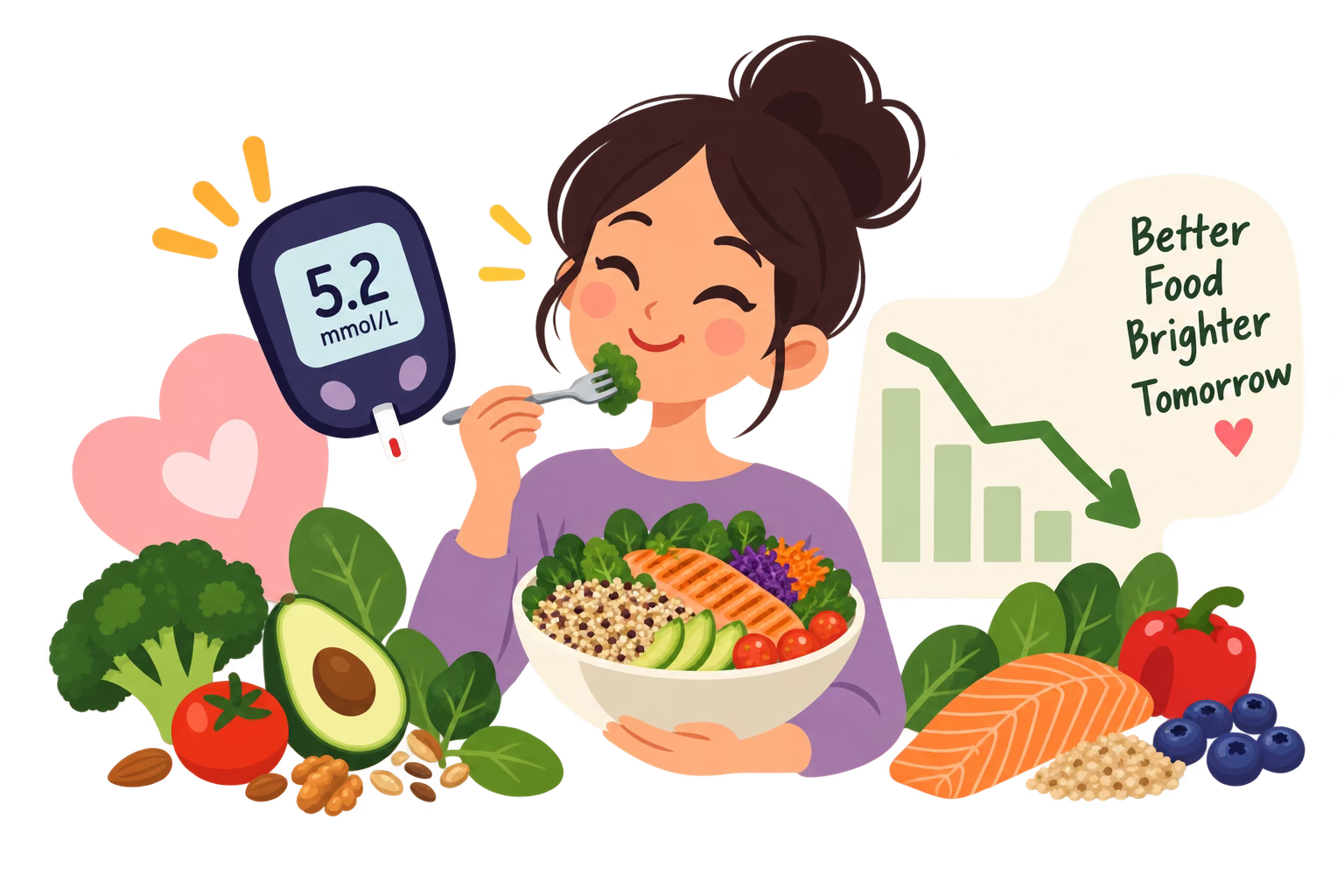
The American Diabetes Association’s Standards of Care in Diabetes—2026 is explicit: there is no single ideal ratio of carbohydrate, fat, and protein that works for everyone. What matters is your overall eating pattern.
The ADA’s core recommendation is to emphasize non-starchy vegetables, whole fruits, legumes, lean proteins, whole grains, nuts and seeds, while minimizing red meat, sugar-sweetened beverages, sweets, refined grains, and ultra-processed foods (Recommendation 5.14, Diabetes Care, 2026).
Several patterns fit this description. But one has been tested more rigorously than any other.
The Mediterranean Diet: The Strongest Evidence We Have
PREDIMED: Diet Alone, Without Calorie Restriction
PREDIMED enrolled 7,447 adults at high cardiovascular risk in Spain and randomized them to a Mediterranean diet with extra-virgin olive oil, a Mediterranean diet with mixed nuts, or a low-fat control diet. After a median of 4.8 years, both Mediterranean groups had roughly 30% fewer major cardiovascular events (Estruch et al., N Engl J Med, 2018).
The diabetes findings are what matter most here. Among the 3,541 participants who did not have diabetes at baseline, 273 developed it. The multivariable-adjusted hazard ratios were 0.60 (95% CI 0.43–0.85) for the olive oil group and 0.82 (0.61–1.10) for the nut group, compared with control (Salas-Salvadó et al., Ann Intern Med, 2014).
That’s a 40% lower risk of developing type 2 diabetes — achieved with no calorie restriction and no prescribed exercise. Diet alone.
PREDIMED-Plus: Adding Calories and Movement
Published in August 2025, the PREDIMED-Plus secondary analysis followed 4,746 adults aged 55–75 with metabolic syndrome and overweight or obesity across 23 Spanish centres for 6 years. Participants received either an energy-reduced Mediterranean diet (–600 kcal/day) plus increased physical activity and behavioural support, or an unrestricted Mediterranean diet.
The intensive group had a 31% lower relative risk of developing type 2 diabetes, with the survival curves separating within the first six months (Ruiz-Canela et al., Ann Intern Med, 2025;178:10).
The Pooled Evidence
A 2025 systematic review and dose–response meta-analysis in Advances in Nutrition synthesized 24 prospective cohorts and one RCT — 991,878 participants, 68,325 diabetes cases, mean follow-up 12.2 years — and concluded with moderate-certainty evidence that greater Mediterranean diet adherence lowers type 2 diabetes risk (Wallerer et al., Adv Nutr, 2025;16:100562).
For people who already have type 2 diabetes, a 2025 meta-analysis of 11 randomized controlled trials found the Mediterranean diet reduced HbA1c by 0.31%, fasting plasma glucose by 0.85 mmol/L, and BMI by 0.83 kg/m² versus control diets (Wu et al., Nutrients, 2025;17:3908).
Fiber: What It Does Specifically for Diabetes
We devoted an entire post to fiber’s role in gut health and weight management (”Beyond the Bulk”). Here I want to focus narrowly on one thing that post didn’t cover: what fiber does for mortality and glycemic control in people who already have diabetes.
A 2020 systematic review and meta-analysis in PLOS Medicine pooled two multi-country cohorts of 8,300 adults with diabetes (mean 8.8 years follow-up) and 42 controlled trials (Reynolds et al.).
The key finding: comparing a daily fiber intake of 35 g with the average intake of 19 g, there were 14 fewer deaths per 1,000 people over the study period — with a clear dose–response relationship. Higher fiber intake also improved HbA1c, fasting glucose, blood lipids, body weight, and inflammatory markers.
The authors concluded that increasing fiber by 15 g/day, or up to 35 g/day, is a reasonable target for adults with diabetes.
The ADA recommends a minimum of 14 g of fiber per 1,000 kcal (Diabetes Care, 2026).
Why This Matters Especially in China
Data from five national Chinese surveys show that in 2015, mean total dietary fiber intake was just 9.7 g per person per day — while the Chinese Nutrition Society recommends 25–30 g. Meanwhile, mean grain consumption was 281.1 g/day, of which only 14.8 g came from grains other than rice and wheat flour (Yu, Zhao & Zhao, Nutrition Reviews, 2020;78[Suppl 1]:43–53).
In other words: the grains are there. The fiber is not.
Carbohydrate Quality: The Rice Question
Rice is not “bad.” But if it’s your staple, the details matter — and the data here is directly relevant to our readers.
The risk is real, and it’s higher in Asian populations. A meta-analysis of seven prospective cohorts — 352,384 participants, 13,284 diabetes cases — found that comparing highest with lowest white rice intake, the pooled relative risk of type 2 diabetes was 1.55 (95% CI 1.20–2.01) in Asian populations, versus a non-significant 1.12 in Western populations. Each additional daily serving raised risk by 11% (RR 1.11, 95% CI 1.08–1.14) (Hu et al., BMJ, 2012;344:e1454).
Swapping matters more than eliminating. In three Harvard cohorts totalling 197,228 adults, replacing just 50 g/day of cooked white rice (about one-third of a serving) with brown rice was associated with a 16% lower diabetes risk (95% CI 9–21%). Replacing the same amount with whole grains as a group was associated with a 36% lower risk (30–42%)(Sun et al., Arch Intern Med, 2010;170:961–969).
Glycemic index holds up at the population level. We unpacked how GI works in “Glycemic Index Decoded” — here’s the hard outcome data. A 2024 meta-analysis of ten mega-cohorts (each ≥100,000 participants) from the Richard Doll Consortium found that high-glycemic-index diets were associated with a 27% higher risk of type 2 diabetes (RR 1.27, 95% CI 1.21–1.34) (Jenkins et al., Lancet Diabetes Endocrinol, 2024;12:107–118).
A practical kitchen trick: cook, cool, reheat. Cooling cooked rice triggers starch retrogradation, converting some digestible starch into resistant starch, which behaves like fiber. In a randomized crossover study, rice cooled for 24 hours at 4°C and reheated contained 1.65 g resistant starch per 100 g versus 0.64 g in freshly cooked rice, and produced a significantly lower glycemic response (Sonia et al., Asia Pac J Clin Nutr, 2015;24:620–625). A 2022 trial in 32 adults with type 1 diabetes confirmed lower peak glucose after cooled rice compared with fresh (Strozyk et al., Nutr Diabetes, 2022;12:16).
What to do: mix brown, red, or whole grains into your rice; keep portions moderate; always eat rice alongside vegetables and protein; and consider cooking rice a day ahead.
What to Eat Less Of: Ultra-Processed Foods
This is where the evidence has become impossible to ignore.
In three large U.S. cohorts — 198,636 participants, 19,503 diabetes cases, 5.2 million person-years — those in the highest quintile of ultra-processed food intake had a 46% higher risk of type 2 diabetes (HR 1.46, 95% CI 1.39–1.54). The quality of the pooled evidence was rated high (Chen et al., Diabetes Care, 2023;46:1335–1344).
A 2025 dose–response meta-analysis of 12 prospective cohorts found a summary relative risk of 1.48 (95% CI 1.36–1.61)comparing highest with lowest intake — and critically, the association held independent of overall diet quality, total calories, and BMI. Processed meats carried the strongest individual signal (RR 1.34, 95% CI 1.16–1.54) (Kim, Cho & Oh, Diabetes Metab J, 2025).
A separate 2025 meta-analysis of 14 cohorts with 692,508 participants reached the same conclusion (Souza et al., Metabolism, 2025;165:156134).
The takeaway: it isn’t only about calories. Something about the ultra-processing itself appears to carry metabolic harm.
Your Plate, Practically
Half your plate: non-starchy vegetables. Fiber and micronutrients, minimal glucose impact.
Upgrade your grains, don’t fear them. Brown rice, barley, oats, buckwheat, whole wheat. Even partial substitution helps.
Eat legumes most days. Lentils, chickpeas, black beans, edamame, tofu — high fiber, high protein, low glycemic index.
Don’t fear healthy fat. PREDIMED’s protective effect came from generous olive oil and nuts, not from restricting fat — exactly the point we made in “The Fat Facts.”
Adapt, don’t abandon your cuisine. As we explored in “Bridging East and West,” these principles work within Chinese cooking. More vegetables, more legumes, better grains — not a different cuisine.
Cut ultra-processed foods and sugary drinks first. The ADA specifically recommends replacing sugar-sweetened beverages, including juices, with water (Recommendation 5.25, Diabetes Care, 2026).
Target 25–35 g of fiber daily. Increase gradually to avoid bloating.
The Bottom Line
No single food prevents or cures diabetes. But the evidence for dietary patterns is strong, consistent, and reproducible across continents.
Eat more whole foods, more fiber, more plants, better fats. Eat fewer ultra-processed foods, fewer sugary drinks, less processed meat. Upgrade your carbohydrates rather than fearing them.
In Part 4, we said prediabetes is reversible. Diet is the most powerful tool you have to reverse it — and unlike a prescription, every meal is a fresh chance to use it.
「药补不如食补」(yào bǔ bù rú shí bǔ)— food is better medicine than medicine itself. On this, the science and the proverb agree.
Coming Up Next
In Part 4, we said prediabetes is reversible. In this post, we covered the food that reverses it. But there’s a bigger question we haven’t asked yet: what if you’ve already crossed the line?
Stay tuned for Part 6: “Can Type 2 Diabetes Be Reversed? What the Remission Research Actually Shows.” For decades, type 2 diabetes was described as lifelong and progressive. Landmark trials have challenged that assumption. We’ll look at who achieves remission, what it takes, how long it lasts, and why the word “reversal” needs to be used carefully.
If you found this helpful, please follow our WeChat page or Substack to support evidence-based nutrition content that’s accessible to everyone! 💚