

Eight posts in, we’ve covered a lot of concepts. This one is different. Everything here you can apply at your next meal, without changing a single item on your plate.
Because it turns out that what you eat isn’t the only thing that determines your blood sugar response. The order you eat it in matters. So does how it was cooked.
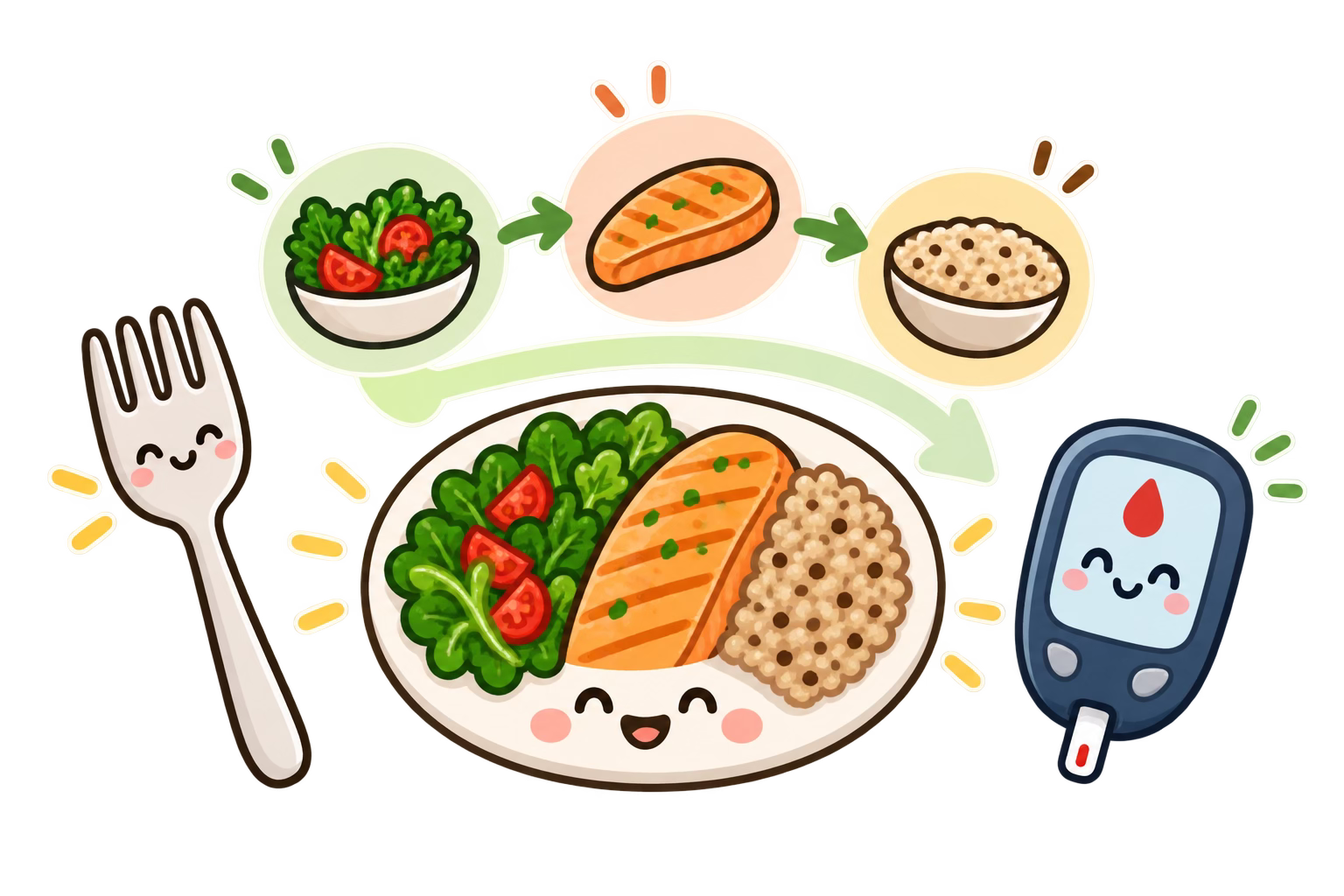
Part One: Eat Your Carbohydrates Last
The Finding
In 2015, researchers at Weill Cornell published a small but striking study in Diabetes Care. Eleven people with type 2 diabetes ate an identical meal — ciabatta bread, orange juice, grilled chicken, salad, and steamed broccoli — on separate days, in two different orders.
When vegetables and protein were eaten first, with the carbohydrate 15 minutes later, compared with carbohydrate first:
Post-meal glucose was 28.6% lower at 30 minutes, 36.7% lower at 60 minutes, and 16.8% lower at 120 minutes
The incremental area under the glucose curve was 73% lower
Insulin levels were also significantly lower
Same food. Same quantity. Same person. Different order (Shukla et al., Diabetes Care, 2015;38:e98–e99).
It Replicates
This wasn’t a one-off.
In prediabetes: Fifteen participants with prediabetes ate the same meal in three different orders. Glucose peaks were reduced by more than 40% when protein and vegetables came first, and the incremental area under the curve was 38.8% lower compared with carbohydrate-first (Shukla et al., Diabetes Obes Metab, 2019).
In type 2 diabetes over three hours: In a crossover study of 16 people with metformin-treated type 2 diabetes, a carbohydrate-last pattern reduced both the incremental glucose area and the glucose peak by over 50%, lowered insulin excursions, and increased GLP-1 — one of the gut hormones that improves post-meal glucose handling.
On appetite: The same research group found that ghrelin — the hunger hormone we covered in “The Hunger Games” — was more suppressed three hours after a carbohydrate-last meal, suggesting effects on satiety as well as glucose (Shukla et al., Diabetes Care, 2018;41:e76–e77).
A 2026 systematic review of meal sequencing in healthy adults reached the same conclusion: eating vegetables, fruits, or protein-rich foods before carbohydrate-rich foods consistently reduced post-meal glucose responses.
Why It Works
Three mechanisms, all covered earlier in this series:
Gastric emptying slows. Protein, fat, and fiber arriving first delay the rate at which carbohydrate reaches your small intestine. Slower delivery means a flatter glucose curve.
Incretin hormones respond. Protein and fat stimulate GLP-1 release, which enhances insulin secretion and further slows gastric emptying.
Fiber forms a physical barrier. Vegetables eaten first create a matrix that slows carbohydrate digestion and absorption.
How to Actually Do This
This is where it becomes very practical for Chinese meals — and honestly, easier than for Western ones.
A traditional Chinese table already serves dishes communally rather than as a single plated meal. The change is behavioural, not culinary:
Start with the vegetable dishes and soup. Give it a few minutes.
Then the protein — fish, tofu, eggs, meat.
Rice or noodles last, rather than as the base you eat everything over.
You don’t need a stopwatch. The trials used 10–15 minute gaps, but the general principle — front-load vegetables and protein, finish with the starch — is what matters.
If you’re eating a bowl-based meal where rice is mixed throughout, the intervention is harder. Serving rice in a separate bowl, as is traditional, actually makes this easier.
Part Two: How You Cook Changes What You Eat
Now the second half — and this one connects directly back to Part 3.
Remember AGEs — advanced glycation end-products, the “sugar rust” that stiffens and inflames blood vessels? In Part 3, we described AGEs forming inside your body when blood sugar stays high.
But AGEs also form in food, during cooking. And the amount depends heavily on cooking method.
High, dry heat generates the most. Grilling, roasting, frying, searing, and barbecuing produce far more AGEs than moist, lower-temperature methods.
Water-based, lower-temperature methods generate the least. Steaming, boiling, poaching, stewing, and braising keep AGE formation substantially lower.
Acidic marinades reduce formation. Marinating in vinegar or citrus before cooking lowers AGE generation.
This is one area where traditional Chinese cooking has real advantages that modern habits have eroded. Steaming (蒸), boiling (煮), stewing (炖), and braising (焖) are all lower-AGE methods and all central to the traditional repertoire. Deep-frying (炸) and high-heat searing are the outliers.
An important caveat on the evidence: the biology of dietary AGEs is well characterized, and trials have shown that lower-AGE diets can reduce circulating AGE and inflammatory markers. But whether reducing dietary AGEs improves hard clinical outcomes like diabetes complications is not yet settled. This is promising, mechanistically sensible, and low-risk — not proven at the level of the trial evidence in Parts 5 and 6. Treat it accordingly.
And One More: Cook, Cool, Reheat
We covered this in Part 5 for rice, and it belongs here too.
Cooling cooked starch triggers retrogradation — some digestible starch converts into resistant starch, which behaves like fiber. Rice cooled for 24 hours at 4°C and reheated contained more than double the resistant starch of freshly cooked rice and produced a significantly lower glycemic response (Sonia et al., Asia Pac J Clin Nutr, 2015).
The same principle applies to potatoes and pasta. Cook ahead, refrigerate, reheat.
The Bottom Line
Almost everything in nutrition advice tells you to change what you eat. This post is about the two things nobody mentions: the sequence and the technique.
The meal-order evidence is genuinely striking — reductions of 30–70% in post-meal glucose from nothing more than rearranging the same plate. The cooking-method evidence is more preliminary but points in a sensible direction, and traditional Chinese methods already favour the better options.
If you’ve found the last several posts conceptually heavy, this is the one to act on tonight.
Coming Up Next
Stay tuned for Part 10, the final post in this series: “Diabetes Across a Lifetime: Pregnancy, Childhood, and Older Age.” Metabolic risk doesn’t look the same at 30, at 8, or at 75. We’ll close the series by looking at how the priorities shift across a life — and what it means for the people you care about, not just yourself.
If you found this helpful, please follow our WeChat page or Substack to support evidence-based nutrition content that’s accessible to everyone! 💚