

Here’s something that should bother anyone who has ever followed a diet plan.
Two people eat the identical meal — same bread, same portion, same time of day. One person’s blood sugar barely moves. The other’s spikes sharply. Same food. Same amount. Completely different outcomes.
For decades, nutrition science treated glycemic response as a property of the food. That’s how glycemic index tables work, and as we covered in “Glycemic Index Decoded,” they’re genuinely useful. But they describe a population average — and a growing body of research suggests the individual variation around that average is large, and partly explained by something we’ve never discussed in this series: the trillions of bacteria in your intestine.
The Study That Made This Undeniable
In 2015, researchers at the Weizmann Institute published a landmark study in Cell. They continuously monitored blood glucose in 800 people for one week, capturing responses to 46,898 meals, while also collecting blood measurements, dietary and lifestyle information, physical activity data, and gut microbiome profiles (Zeevi et al., Cell, 2015;163:1079–1094).
What they found challenged the idea that a food has one predictable effect on everyone’s blood sugar. People often had dramatically different glucose responses to the same foods and meals. A meal that produced a relatively modest rise in one person’s glucose could cause a much larger spike in someone else.
The researchers then asked whether those differences could actually be predicted. They developed a machine-learning algorithm that combined information about the meal with individual characteristics—including clinical measurements, lifestyle factors, and features of the gut microbiome. The model successfully predicted people’s post-meal glucose responses and was validated in a separate group of 100 participants.
They took the idea one step further by testing personalized dietary advice. Participants were given individually tailored “good” and “bad” diets based on their predicted glucose responses. The personalized diets produced significantly different post-meal glucose responses as intended and were also associated with changes in the gut microbiome.
The takeaway wasn’t that glycemic index or carbohydrate content suddenly became irrelevant. It was that the food is only part of the equation. The person eating it matters too—and the gut microbiome appears to be one piece of that individual response.
What Your Gut Bacteria Actually Do
Three mechanisms are best supported:
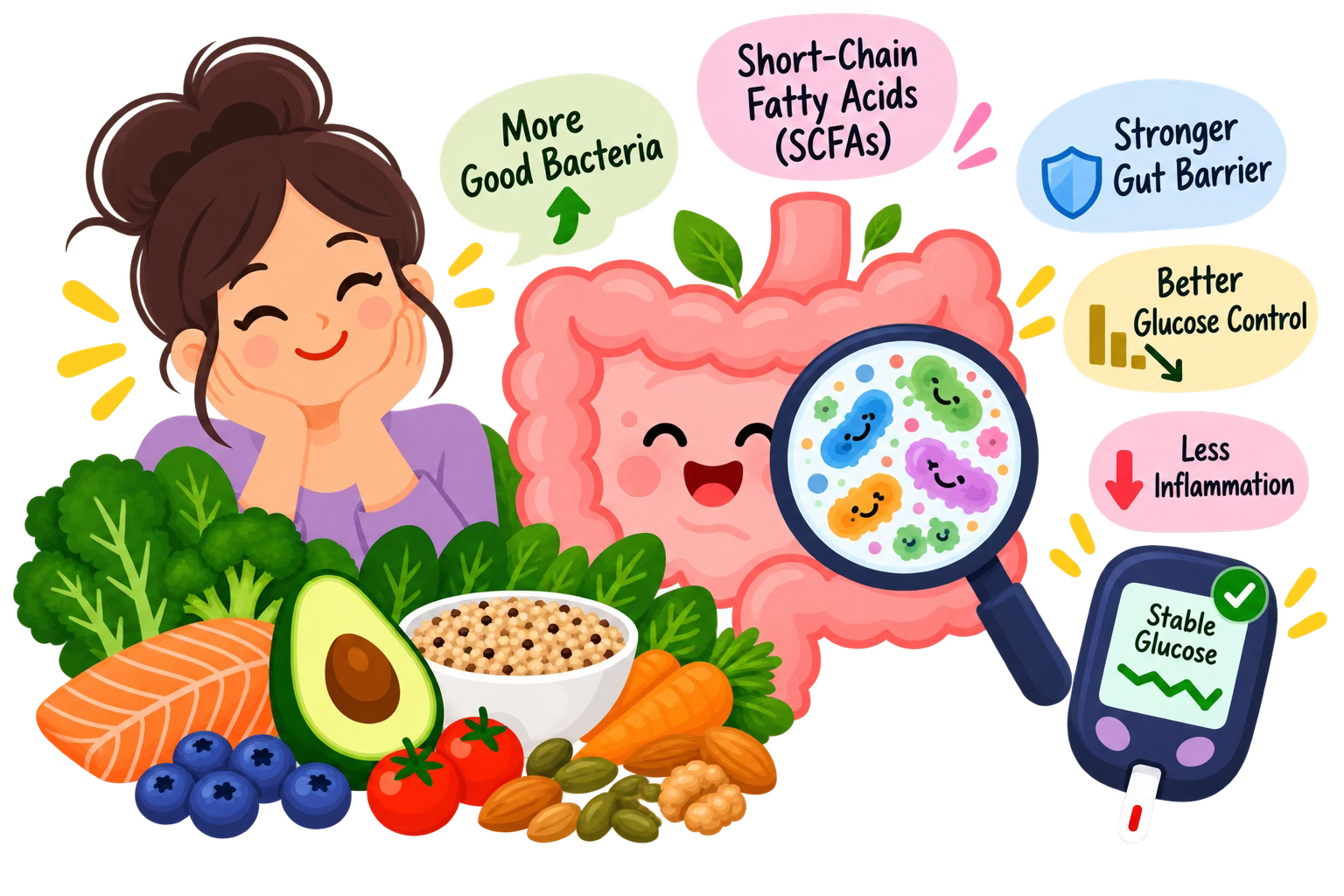
They ferment fiber into short-chain fatty acids. Fiber that your own enzymes cannot digest is broken down by colonic bacteria into short-chain fatty acids — mainly butyrate, propionate, and acetate. These are absorbed and influence appetite hormones, liver glucose production, and inflammation. This is a large part of why the fiber evidence in Part 5 is so consistent.
They influence gut barrier integrity. A well-fed, diverse microbiome supports the intestinal lining. When that barrier becomes leaky, bacterial fragments can enter circulation and drive low-grade systemic inflammation — a recognized contributor to insulin resistance.
They shape how quickly carbohydrate reaches you. Microbial activity affects gut transit, bile acid signalling, and incretin hormone release, all of which alter the shape of your post-meal glucose curve.
What Actually Feeds a Healthy Microbiome
This is the practical part, and the honest answer is that it looks remarkably like the eating pattern from Part 5.
Fiber diversity matters, not just fiber quantity. Different bacterial species ferment different fibers. A diet with oats, beans, vegetables, nuts, and whole grains supports a broader microbial community than one relying on a single fiber source.
Fermented foods have supporting evidence. Yogurt, kefir, and traditionally fermented vegetables introduce live microbes and fermentation by-products. In Chinese cuisine, foods like 泡菜 and 豆豉 fit here naturally — though commercially produced versions are often high in sodium, which matters for blood pressure.
Polyphenol-rich foods act as microbial food. Tea, berries, olive oil, herbs, and spices contain compounds that are metabolized by gut bacteria rather than absorbed directly.
Ultra-processed foods appear to work against it. As we covered in Part 5, ultra-processed food intake is associated with substantially higher diabetes risk even after adjusting for calories and BMI. Effects on the microbiome and gut barrier are among the leading proposed explanations for why the association survives that adjustment.
Where the Evidence Is Still Thin
Being honest about limits matters here, because this field attracts more hype than almost any other in nutrition.
There is no validated “good microbiome” profile. No test currently tells you your microbiome is healthy or unhealthy in a clinically actionable way. Direct-to-consumer microbiome tests are ahead of the science.
Most probiotic supplements have modest, strain-specific, and often transient effects. A probiotic capsule is not equivalent to a fiber-rich diet, and benefits shown for one strain do not transfer to another.
Causality is often unclear. Many microbiome differences observed in people with diabetes could be consequences of the disease or the diet rather than causes of it.
Personalized nutrition algorithms are promising but early. They perform well in research settings. Whether they improve long-term HbA1c or hard clinical outcomes at population scale is not yet established.
What This Means for You
The practical conclusion is less exotic than the science suggests, and that’s reassuring rather than disappointing.
Feed your gut variety. Aim for a wide range of plant foods across a week rather than the same three vegetables daily.
Prioritize fiber from whole sources. This remains the single best-supported microbiome intervention, and it’s the same advice the glycemic and mortality data gave us in Part 5.
Notice your own responses. If you have access to glucose monitoring — through a meter or a continuous monitor — you may find that a food considered “healthy” spikes you, or that one considered risky doesn’t. Population averages are a starting point, not a verdict.
Be skeptical of microbiome products. The biology is real. Most of the commercial products built on it are running ahead of the evidence.
The Bottom Line
Food is not the only variable in your blood sugar response — you are a variable too. Your gut microbiome helps explain why the same meal produces different results in different people, and why rigid universal diet rules so often disappoint.
But notice where this lands. The way to support a healthy microbiome is diverse plants, abundant fiber, fermented foods, and fewer ultra-processed products. Which is, almost exactly, the eating pattern that the trial evidence in Part 5 already pointed to.
Sometimes new science doesn’t overturn the old advice. It explains why it worked.
Coming Up Next
Stay tuned for Part 8: “The Silent Partner: Fatty Liver Disease and Insulin Resistance.” In Part 3 we covered what high blood sugar does to your eyes, kidneys, nerves, and heart. We left out one organ — the one most closely tied to insulin resistance, affecting roughly a third of adults worldwide, and almost never screened for.
If you found this helpful, please follow our WeChat page or Substack to support evidence-based nutrition content that’s accessible to everyone! 💚