

In Part 4, we said prediabetes is reversible. In Part 5, we covered the food that reverses it. But a lot of readers are past that stage — already diagnosed, already on medication, already told this is permanent.
For decades, that’s what type 2 diabetes was: lifelong and progressive. Manage it, slow it, but never undo it.
That assumption has been formally challenged. Here’s what the evidence actually shows — and, just as importantly, what it doesn’t.
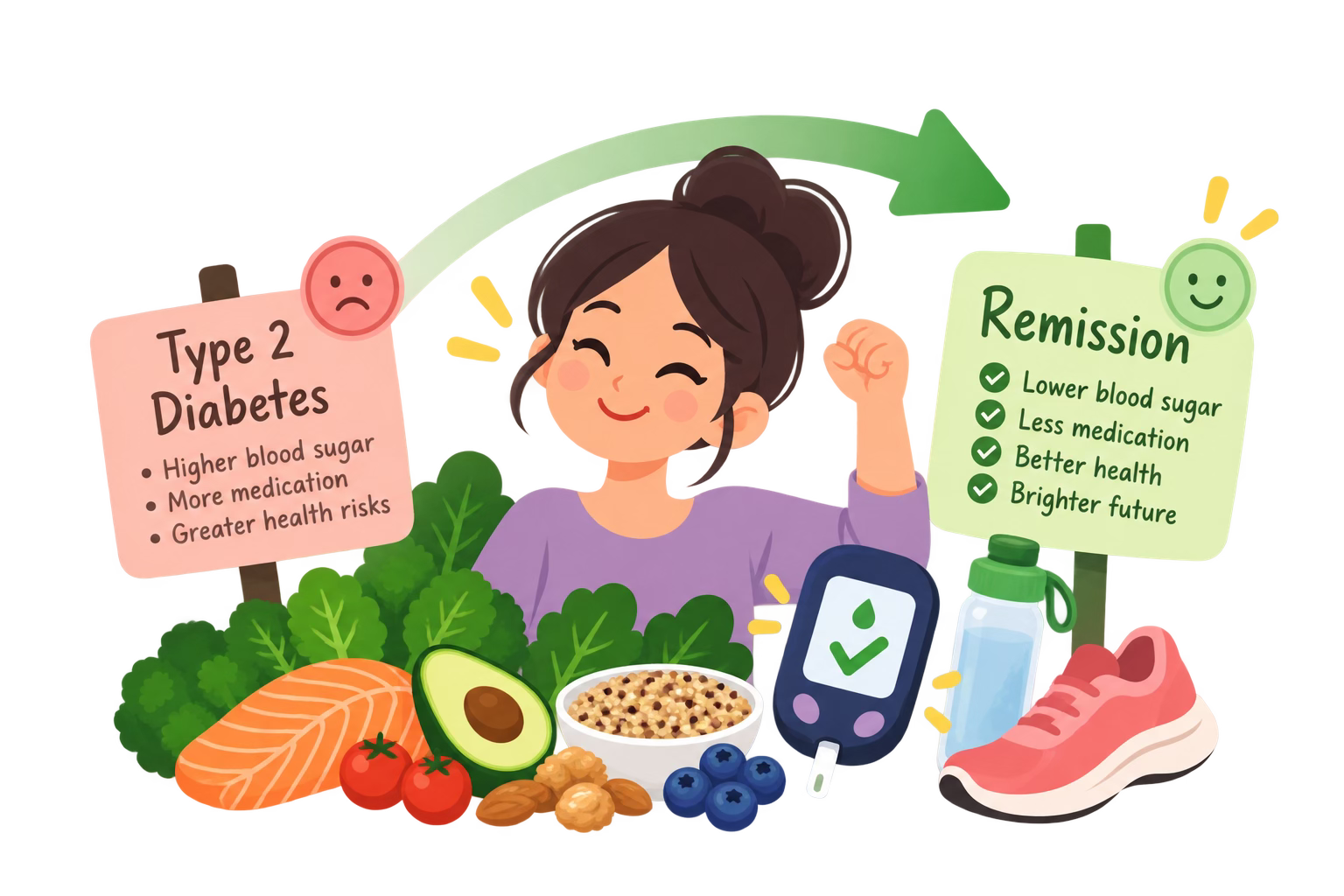
First, What Does “Remission” Even Mean?
Precision matters here, because this is a word people misuse constantly.
In 2021, an international expert group convened by the American Diabetes Association — with the Endocrine Society, the European Association for the Study of Diabetes, and Diabetes UK — published a consensus definition. They deliberately chose “remission,” not “cure” or “reversal.”
Their criterion: HbA1c below 6.5% (48 mmol/mol), measured at least 3 months after stopping all glucose-lowering medication (Riddle et al., Diabetes Care, 2021;44:2438–2444).
Three things about that definition deserve emphasis:
Off medication. Normal blood sugar while taking medication is good control, not remission.
Sustained. A single good reading doesn’t count.
Not a cure. The consensus group was explicit: diabetes can return, and complications can still progress. They recommend continued annual screening for everyone in remission.
DiRECT: The Trial That Changed the Conversation
The Diabetes Remission Clinical Trial (DiRECT) ran in UK primary care practices — ordinary GP surgeries, not specialist centres. It recruited 306 adults aged 20–65 with type 2 diabetes of less than 6 years’ duration, BMI above 27 kg/m², and not on insulin.
The intervention was demanding but simple: withdraw diabetes and blood pressure medications, then a total diet replacement of 825–853 kcal per day using formula products for 12–20 weeks, followed by structured food reintroduction and long-term weight-maintenance support.
At 12 months (Lean et al., Lancet, 2018;391:541–551):
46% of the intervention group achieved remission, versus 4% of the control group (odds ratio 19.7, 95% CI 7.8–49.8)
Mean weight loss was 10.0 kg, versus 1.0 kg in controls
But the most instructive finding was the relationship between weight loss and remission:
Weight change Achieved remission
Gained weight 0 of 76 (0%)
Lost 0–5 kg 6 of 89 (7%)
Lost 5–10 kg 19 of 56 (34%)
Lost 10–15 kg 16 of 28 (57%)
Lost 15 kg or more 31 of 36 (86%)
Remission wasn’t random. It tracked weight loss almost linearly.
What Happened Over Five Years
This is where the story becomes honest rather than triumphant.
At 2 years, remission had fallen from 46% to 36%. Among those who had maintained more than 10 kg of weight loss, 29 of 36 (81%) were still in remission (Lean et al., Lancet Diabetes Endocrinol, 2019;7:344–355).
At 5 years, with continued low-intensity dietary support, 13% of those with available data remained in remission. Of the participants who had been in remission at year 2, 26% were still in remission at year 5. Those who sustained remission had maintained an average weight loss of 8.9 kg (Lean et al., Lancet Diabetes Endocrinol, 2024;12:233–246).
Compared with the control group over those five years, the original intervention group spent more time with weight more than 5% below baseline (61% vs 29%), more time with HbA1c below the diabetes threshold (29% vs 15%), and more time free of diabetes medication (51% vs 16%). The intervention group also had roughly half the number of serious medical events requiring hospitalisation.
So: remission is real, it is achievable in ordinary primary care, and it is hard to hold onto. All three of those things are true at once.
It Works Outside the UK, Too
DIADEM-I tested a similar approach in a younger, Middle Eastern and North African population — 147 adults with type 2 diabetes of less than 3 years’ duration, recruited through primary care in Qatar.
At 12 months, 61% of the intervention group achieved remission, versus 12% of controls (odds ratio 12.03, 95% CI 5.17–28.03). A third achieved fully normal glucose levels (Taheri et al., Lancet Diabetes Endocrinol, 2020;8:477–489).
The researchers attributed the higher rate partly to participants being roughly a decade younger than in DiRECT, with shorter diabetes duration.
Who Is Most Likely to Achieve Remission?
Across these trials, the pattern is consistent:
Shorter duration of diabetes. DiRECT required under 6 years; DIADEM-I under 3. The earlier you act, the better the odds.
Greater weight loss. The dose–response relationship in the DiRECT table above is the single clearest finding in this literature.
Not yet on insulin. Both trials excluded insulin users — remission after insulin dependence is far less studied.
Preserved beta-cell capacity. Mechanistic work from the DiRECT team showed that remission required reductions in liver and pancreas fat, but only occurred in people whose insulin-producing cells could still recover (Taylor et al., Cell Metab, 2018;28:547–556).
This last point connects back to Part 1 and Part 2 of this series. The pancreas that “developed trust issues” can sometimes be talked back — but not indefinitely, and not by everyone.
Important Cautions
Remission is not a cure. Diabetes can return, and did for most DiRECT participants within five years. Annual screening for eye, kidney, and nerve complications must continue regardless.
These were medically supervised programmes. DiRECT participants had their medications withdrawn by clinicians, under monitoring. Very-low-calorie diets are not something to attempt alone, especially on glucose-lowering or blood-pressure medication.
Rapid glucose reduction has its own risks. The consensus report specifically warns that people with existing retinopathy beyond microaneurysms should avoid rapid drops in glucose, and should have repeat retinal screening if levels fall quickly.
Not everyone can achieve it. People with longer-duration diabetes, on insulin, or with substantially depleted beta-cell function may not reach remission — and that is not a personal failure. Excellent glucose control on medication remains an outstanding outcome.
The Bottom Line
Type 2 diabetes is not automatically a life sentence. In the right people — diagnosed recently, not on insulin, able to achieve substantial and sustained weight loss — remission is genuinely achievable, and the evidence now comes from randomised trials in ordinary clinics, not fringe claims.
But the same evidence is clear that remission is easier to reach than to keep. The five-year data shows the honest picture: those who maintained the weight loss maintained the remission. Those who didn’t, didn’t.
Which brings us back to where Part 5 ended. The mechanism is weight loss. The vehicle is food. And it isn’t a 12-week project — it’s a way of eating you can live with.
Coming Up Next
Stay tuned for Part 7: “Your Gut, Your Glucose: Why the Same Meal Affects Two People Differently.” If diet drives remission, why does identical food produce wildly different blood sugar responses in different people? The answer involves trillions of bacteria — and it’s changing how nutrition science thinks about personalization.
If you found this helpful, please follow our WeChat page or Substack to support evidence-based nutrition content that’s accessible to everyone! 💚